

 Image 1 of 1
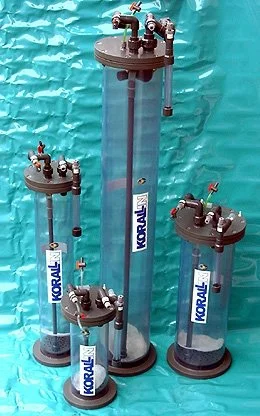
Korallin C4002 or S4002 body only.
Can also be used as a calcium reactor or denirtrator
Denitrator rated for 1000 gallons, Calcium reactor rated for 800 gallons
Measures 21” tall x 8”x 8”
Description
The best-selling Kalkreaktor (Calcium Reactor) in Germany completely replaces Kalkwasser, 1 or 2-part Calcium/Buffer powder & liquid dosing. The new and improved Korallin kalkreaktor allows a simple, elegant and high efficiency production of calcium hydrogen carbonate including the necessary balanced carbonic acid. Sit back and watch your aquarium's pH and dKH being kept at optimum levels. Together with a reliable CO2 set-up, this is the most maintenance-free Kalkreaktor setup in the world.
The internal recirculation flow rate of the C-1502 is around 80 g/h. Since that this is a pressurized Kalkreaktor, the dissolution of the media by the carbonized water is enhanced. The effluent rate is only about 0.25 g/h at 40 drops/min. Thus explaining the efficient CO2 & media use. CO2 is being introduced into the Eheim powerhead direct—this is the most efficient Aspirating-Venturi method. A pH Controller is not required for this Kalkreaktor because there is no chance for the excessive CO2 to escape into your system.
Specifications
Korallin S-4002 rated for up to 1000 gal.
More Info:
The Use of Sulfur (Sulphur) Denitrators
Over the last few years, Sulfur (Sulphur) denitrators have grown in popularity in Europe from humble beginnings in public aquaria to being used in cutting edge integrated filter systems.
Existing Methods
Before we recommend a new process to customers, we make sure we have tested them ourselves on our own systems. We have long held the view that if you design a natural system with the management of nutrients in mind, nitrate and phosphate can be almost forgotten. But with all the best laid plans, you often end up with excess nutrients. These may be due to a higher load of fish or inefficiency in the system’s denitrification abilities. Either way; even the best systems can end up with a nagging 10-20ppm of residue nitrate. The options currently available to resolve excess nitrate would normally take the route of increasing water changes, adding more live rock, or increasing things like the deep sand beds or adding mangroves.
An option that many people have tried is the slow flow denitrator. These rely on anaerobic bacteria, colonising a suitable medium and the flow of water being slow enough, to become depleted of oxygen to create an environment they can thrive in. These bacteria will then multiply and consume the nitrate in the low oxygen water. If well set-up this method can be quite successful.
Enter Sulfur (Sulphur) Denitrators
Guy Martin from Ecole Nationale Supérieure de Rennes did the original work on fresh water treatments plants, although the science may pre-date this. The work was transferred to the marine environment and used by Michel Hignette, curator of the MAAO aquarium. A pilot project was launched. Since then the experiment was done on a much bigger scale, at the MAAO, as well as in the Grand Aquarium in Saint-Malo. All of these systems have been a great success and the systems have proved a real boon in large scale aquariums where the management of nitrate is often an after thought, when feeding displays stocked with large fish with voracious appetites. After these successes, there have been many Sulfur (Sulphur) denitrators added to private aquariums across the continent.
Simple to set-up and manage.
Needs no additional feeding with carbon based foods.
Works well without the cost of additional electronic control.
Will supply additional calcium to the tank when used as per instructions.
Units can be ran in series for management of higher nitrate levels.
Long lasting: up to 2-3 years.
Units can be easily refilled.
S4001 = European Version with 230/220 V
S4002 = USA version with 110 V
Can also be used as a calcium reactor or denirtrator
Denitrator rated for 1000 gallons, Calcium reactor rated for 800 gallons
Measures 21” tall x 8”x 8”
Description
The best-selling Kalkreaktor (Calcium Reactor) in Germany completely replaces Kalkwasser, 1 or 2-part Calcium/Buffer powder & liquid dosing. The new and improved Korallin kalkreaktor allows a simple, elegant and high efficiency production of calcium hydrogen carbonate including the necessary balanced carbonic acid. Sit back and watch your aquarium's pH and dKH being kept at optimum levels. Together with a reliable CO2 set-up, this is the most maintenance-free Kalkreaktor setup in the world.
The internal recirculation flow rate of the C-1502 is around 80 g/h. Since that this is a pressurized Kalkreaktor, the dissolution of the media by the carbonized water is enhanced. The effluent rate is only about 0.25 g/h at 40 drops/min. Thus explaining the efficient CO2 & media use. CO2 is being introduced into the Eheim powerhead direct—this is the most efficient Aspirating-Venturi method. A pH Controller is not required for this Kalkreaktor because there is no chance for the excessive CO2 to escape into your system.
Specifications
Korallin S-4002 rated for up to 1000 gal.
More Info:
The Use of Sulfur (Sulphur) Denitrators
Over the last few years, Sulfur (Sulphur) denitrators have grown in popularity in Europe from humble beginnings in public aquaria to being used in cutting edge integrated filter systems.
Existing Methods
Before we recommend a new process to customers, we make sure we have tested them ourselves on our own systems. We have long held the view that if you design a natural system with the management of nutrients in mind, nitrate and phosphate can be almost forgotten. But with all the best laid plans, you often end up with excess nutrients. These may be due to a higher load of fish or inefficiency in the system’s denitrification abilities. Either way; even the best systems can end up with a nagging 10-20ppm of residue nitrate. The options currently available to resolve excess nitrate would normally take the route of increasing water changes, adding more live rock, or increasing things like the deep sand beds or adding mangroves.
An option that many people have tried is the slow flow denitrator. These rely on anaerobic bacteria, colonising a suitable medium and the flow of water being slow enough, to become depleted of oxygen to create an environment they can thrive in. These bacteria will then multiply and consume the nitrate in the low oxygen water. If well set-up this method can be quite successful.
Enter Sulfur (Sulphur) Denitrators
Guy Martin from Ecole Nationale Supérieure de Rennes did the original work on fresh water treatments plants, although the science may pre-date this. The work was transferred to the marine environment and used by Michel Hignette, curator of the MAAO aquarium. A pilot project was launched. Since then the experiment was done on a much bigger scale, at the MAAO, as well as in the Grand Aquarium in Saint-Malo. All of these systems have been a great success and the systems have proved a real boon in large scale aquariums where the management of nitrate is often an after thought, when feeding displays stocked with large fish with voracious appetites. After these successes, there have been many Sulfur (Sulphur) denitrators added to private aquariums across the continent.
Simple to set-up and manage.
Needs no additional feeding with carbon based foods.
Works well without the cost of additional electronic control.
Will supply additional calcium to the tank when used as per instructions.
Units can be ran in series for management of higher nitrate levels.
Long lasting: up to 2-3 years.
Units can be easily refilled.
S4001 = European Version with 230/220 V
S4002 = USA version with 110 V